Most people treat keyword research like a shopping list. Find keywords, assign one per page, publish, repeat. That approach worked in 2015. In 2026, it mostly produces a site full of pages that compete with each other and rank for nothing.
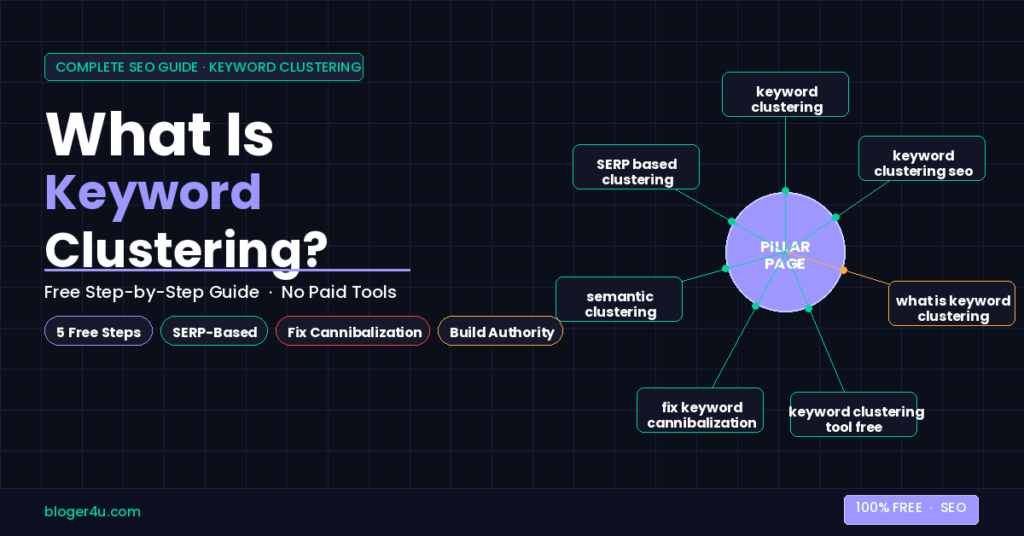
Keyword clustering fixes that. Instead of one keyword per page, you group related keywords by shared search intent and target the entire group with a single well-built page. One page, multiple rankings. Less content, more traffic.
Five methods, zero paid tools, and a free keyword clustering tool at the end if you want to skip the manual work.
What Is Keyword Clustering in SEO?
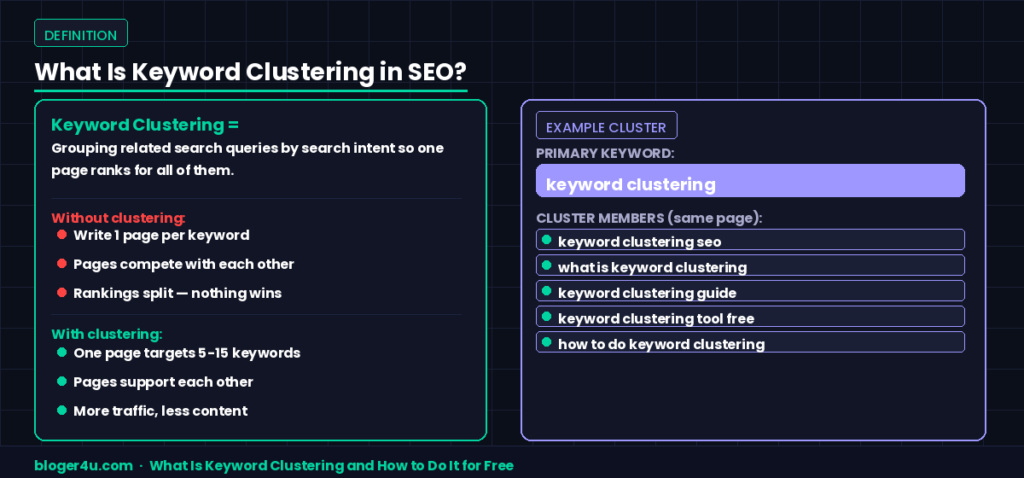
Keyword clustering is the practice of grouping related search queries together so you can target them on a single page rather than building separate pages for each one.
Here’s a simple example. Someone searching “best sofa for small living room” and someone searching “comfortable sofa for small apartment” want the same thing. Google shows the same pages in both results. That’s your signal to put both keywords in one article instead of writing two nearly identical ones.
Semrush describes keyword clustering as targeting a primary keyword alongside secondary keywords that share the same search intent on a single page. One page ends up ranking for a wider range of queries without you writing twice as much content.
Keyword Clustering vs Topic Clusters — What’s the Difference?
People mix these up constantly, and honestly, the confusion is understandable.
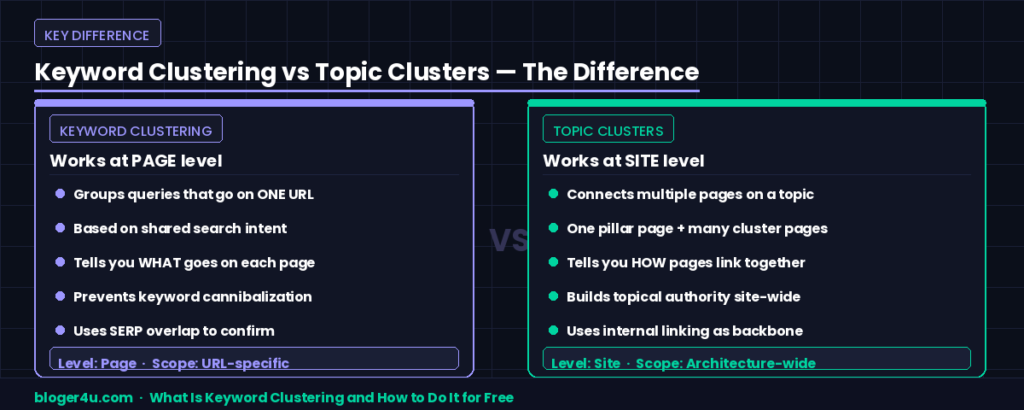
Keyword clustering works at the page level. You group specific search queries that belong on the same URL. “Best running shoes flat feet” and “running shoes for wide feet” go on one page because Google ranks the same URLs for both.
Topic clusters work at the site level. You build a pillar page on a broad topic, then create several supporting pages around subtopics, and link them all together. The pillar page is the hub. The cluster pages are the spokes.
Think of it this way: keyword clustering tells you what goes on each page. Topic clustering tells you how pages connect to each other. You need both. One without the other is half a strategy.
Why Keyword Clustering Matters More in 2026
Google hasn’t ranked individual keywords in isolation for years. Since the Hummingbird update in 2013, Google reads pages for topic coverage, not keyword matches. That gap between old SEO and new SEO widens every year.
When you publish separate pages for every slight keyword variation, you create a problem called keyword cannibalization — multiple pages on your own site competing for the same search intent. Google hesitates. Rankings rotate between your pages. Neither one wins.
An SEO agency called Victorious studied what happens when you consolidate cannibalized pages into one. The average result: a 37% increase in organic traffic to the surviving page. The page inherits the authority from both, and Google stops splitting its attention between them.
The 3 Methods of Keyword Clustering
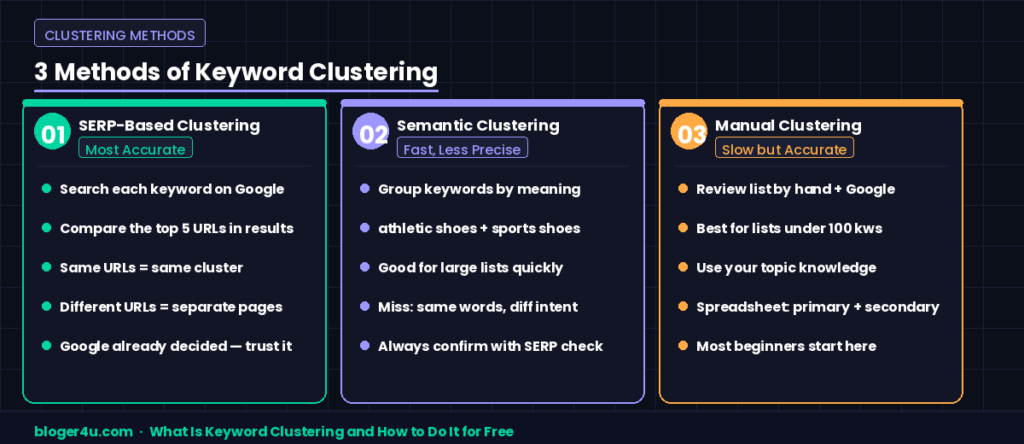
1. SERP-Based Clustering
This is the most accurate method. You check whether different keywords return the same top-ranking URLs on Google. If they do, those keywords share intent and belong in one cluster. If they don’t, they need separate pages.
The logic: Google already decided what content satisfies each query. If Google shows the same page for two queries, that’s your confirmation to cluster them together.
2. Semantic Clustering
This groups keywords by meaning rather than SERP data. “Athletic shoes,” “sports shoes,” and “tennis shoes” are semantically related — similar words, similar meaning. Semantic Clustering is faster but less accurate. Two keywords can share words but need completely different pages. “Espresso machine” and “how to clean an espresso machine” share the same root topic but serve different intentions.
3. Manual Clustering
You go through your keyword list by hand and group them based on your knowledge of the topic and a quick Google check. Slow for large lists. Surprisingly accurate for small ones. Most beginners start here.
For most sites under 500 keywords, a combination of manual review and a free tool gives you everything you need.
How to Do Keyword Clustering for Free — Step by Step
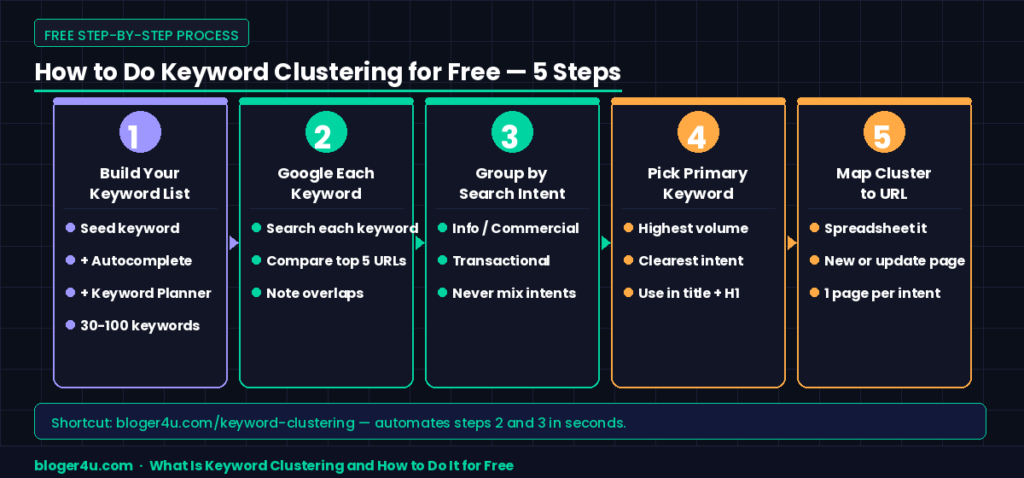
Step 1: Build your raw keyword list
Start with a seed keyword — one broad term that describes your topic. Run it through Google Keyword Planner, search for it on Google and note the autocomplete suggestions, and scroll through the “People Also Ask” boxes. You should walk away with 30 to 100 related queries.
Step 2: Search each keyword on Google
This takes time, but it’s the only way to be certain. Search your keywords and compare the top 5 results. If two keywords show mostly the same URLs, they belong in the same cluster. If the results look completely different, separate pages.
Step 3: Group by search intent
Once you’ve checked SERPs, sort your list into four buckets:
- Informational — “what is keyword clustering”, “how does keyword clustering work”
- Commercial — “best keyword clustering tool”, “keyword clustering tool free”
- Transactional — “keyword clustering software download”
- Navigational — “Semrush keyword clustering”
Never mix intent types into one cluster. An informational guide and a commercial comparison page serve different users and need separate URLs.
Step 4: Pick a primary keyword per cluster
From each group, choose the keyword with the highest search volume and the clearest intent. That’s your primary keyword — the one you put in the title, H1, and meta description. The rest of the cluster members become secondary keywords you weave naturally into the content.
Step 5: Map each cluster to a URL
Create a spreadsheet. One row per cluster. Columns for primary keyword, secondary keywords, intent type, and the URL it should live on. If no page exists yet, create one. If a page already exists and partially covers the topic, update it.
Want to skip the manual SERP checking? The free keyword clustering tool on bloger4u.com automates the grouping so you can paste your list and get clusters in seconds.
How Keyword Clustering Fixes Keyword Cannibalization
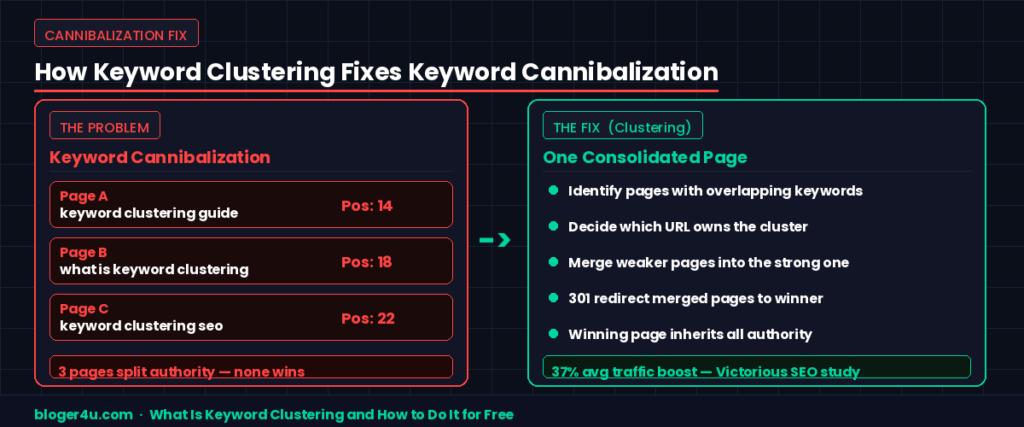
Keyword cannibalization happens when two or more pages on your site compete for the same query. You’ve done the work twice, split the authority in half, and confused Google about which page to rank.
Clustering prevents this from the start. When you plan which keywords go on which URL before you write, you stop building competing pages entirely.
If you have an existing site with cannibalization already happening, Clustering is how you fix it. Identify pages that target overlapping keywords. Decide which URL should own that cluster. Merge the weaker page into the stronger one or redirect it. The surviving page inherits authority from both, and your ranking in that cluster stabilizes.
Internal Linking Inside a Keyword Cluster
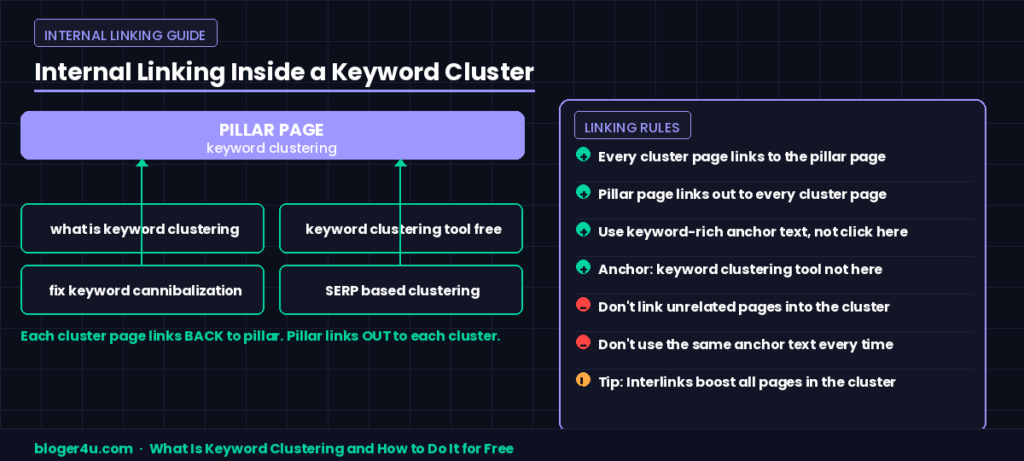
Building the cluster is step one. Linking between cluster pages is step two — and most people skip it.
Every supporting page in a cluster links back to the pillar page. The pillar page links out to each supporting page. This tells Google that these pages form a connected topic, not a random collection of articles.
Keep anchor text specific. Instead of linking with “click here,” use the actual target keyword — “free keyword clustering tool” or “how to fix keyword cannibalization.” Specific anchor text carries far more context for search engines.
Frequently Asked Questions
How many keywords should go in one cluster?
There’s no fixed number. A typical cluster has 3 to 15 keywords. If the SERP data confirms the same URLs rank for all of them, they belong together regardless of the count.
Is keyword clustering the same as topic clustering?
No. Keyword clustering works at the page level — what keywords go on one URL. Topic clustering works at the site level — how pages connect to each other to build topical authority.
What Is Keyword Clustering and Why Does My Website Need It?
Keyword clustering means grouping similar keywords based on search intent. It helps you rank for multiple keywords with one page, improve SEO structure, and avoid duplicate content.
How to Cluster Keywords for Free (No Tools Required)
List your keywords, search them on Google, check whether the same results appear, and group similar ones together. Then choose one main keyword and use the rest as supporting keywords.
Keyword Clustering Examples: Real-World Cases Explained
For “running shoes,” keywords such as best running shoes, cheap running shoes, and running shoes for beginners can be grouped into a single cluster and targeted in a single article.
Final Thoughts
Keyword clustering is not a new concept, but most sites still ignore it. The result is a messy architecture where pages fight each other, and nothing ranks as well as it should.
The fix is straightforward. Group keywords by intent before you write. Build one strong page per cluster. Link your cluster pages together. Let Google understand your site as a topical authority on a subject rather than a scattered pile of articles.
You can do this manually with a spreadsheet and Google. Or you can use the free keyword clustering tool on bloger4u.com and cut the setup time down considerably. Both paths end at the same place — a cleaner site that ranks for more queries with less content.